The director starts her role with confidence and a clear sense of direction
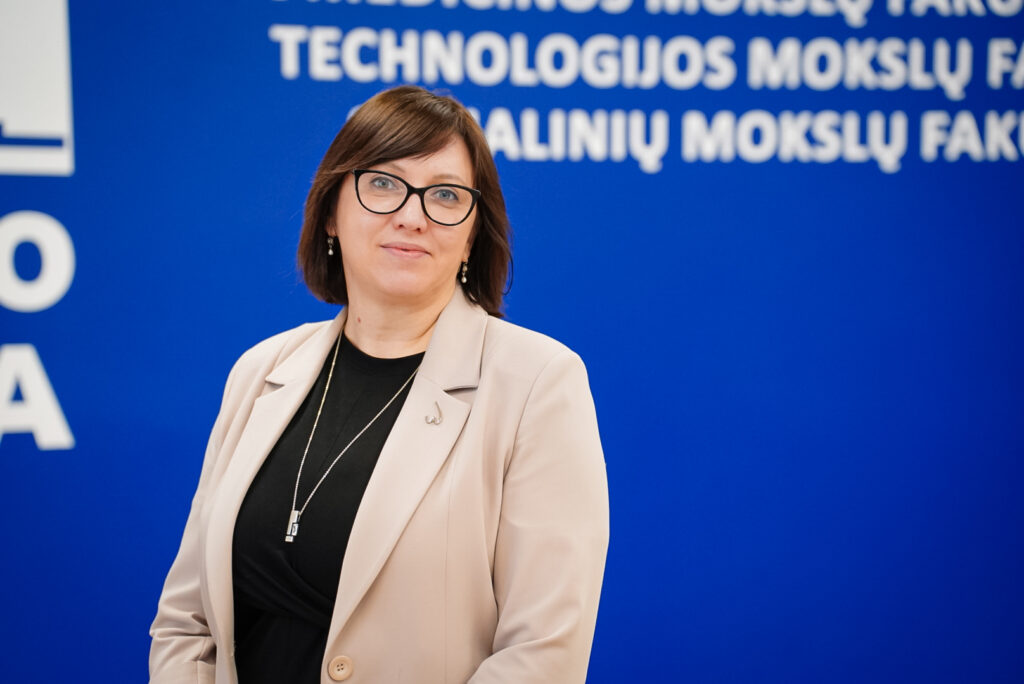 Today marks the beginning of the term of the new Director of Panevėžio kolegija/State Higher Education Institution, Dr. Jurgita Lieponienė. Let’s get to know her better.
Dr. Lieponienė previously served as Deputy Director for Studies and has been working at Panevėžio kolegija/State Higher Education Institution since its establishment. She holds a Bachelor’s and Master’s degree in Mathematics from Vilnius University, as well as a Master’s degree in Informatics Engineering, and she defended her doctoral dissertation in Informatics Engineering at VILNIUS TECH.
– First of all, congratulations on starting your new position. What are your feelings as you begin your term?
I am beginning this term with a strong sense of responsibility, but also with confidence and a clear direction. My mood is focused and positive, as I see that Panevėžio kolegija/State Higher Education Institution has a solid foundation for growth. I believe in our community and its ability to unite around common goals. Therefore, the most important thing now is to move forward consistently, strengthen what we have already built, and make the best possible use of our community’s potential.
– When running for the position of Director, you presented a five-year program focused on growth, ambition, and responsibility. Could you briefly introduce it? What developments can we expect in the near future?
The program focuses on three main directions: strengthening the quality and internationalization of studies, developing applied research, and ensuring the sustainable operation of the institution. The vision is to become a modern university of applied sciences, visible in the international arena—a regional hub for knowledge, technology, and talent.
In the near future, we will implement a student internship and career management system that will enable our students to gain practical experience not only in the region but also in the most advanced companies in Lithuania and abroad. At the same time, we will expand internationalization by introducing mobility windows, promoting short-term mobility, and developing double degree programs. In the field of lifelong learning, we plan to introduce a micro-credential system.
In applied research, we will consistently strengthen research teams, develop their competencies, encourage lecturers to pursue doctoral studies, and attract leading researchers and scientists from foreign universities. We will also seek to join the international university alliance “SUNRISE Alliance” and, together with partners, carry out joint applied research, projects, and publications. We will purposefully utilize the infrastructure of the Applied Research and Innovation Center and actively involve students in applied research activities, strengthening lecturer–researcher mentorship.
We will devote significant attention to talent development and institutional strengthening by implementing a lecturer career management system, launching a student talent program, modernizing infrastructure, and enhancing digitalization.
– Education is identified as one of the strategic priorities at both national and municipal levels. Through which concrete decisions and initiatives does Panevėžio kolegija/State Higher Education Institution currently contribute most to regional growth?
Panevėžio kolegija/State Higher Education Institution contributes to regional growth by preparing specialists needed in the labor market in the fields of healthcare, education, social services, technology, and business. This helps reduce the shortage of specialists and strengthens the region’s economic and social development.
An important part of the institution’s activities is applied research focused on solving practical regional challenges. R&D activities include solutions in smart information systems and data analytics, engineering of robotic and automated processes, materials engineering, energy efficiency and sustainable construction solutions, public health and well-being technologies, as well as innovations in organizational management and public policy. These activities are carried out in close cooperation with social partners.
The institution also actively develops non-formal education by offering programs that enable residents of the region to acquire new competencies, retrain, or update their existing skills and adapt to the changing needs of the labor market.